|
Bank Collapse
Sat. 7th Dec., 2002
|
 |
|
|
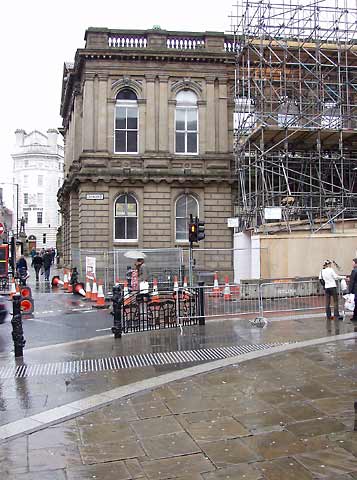
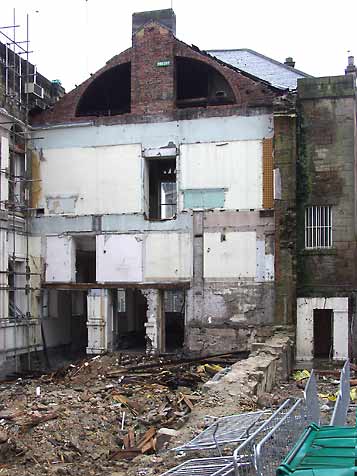
About three months ago work started on removing the internal structure from the old Trustee Savings Bank at the corner of
Grainger Street and Westgate Road. The preserved external shell is to house modern purpose built insides to give this grand old lady a new lease of life.
However, on 30th August the Fates
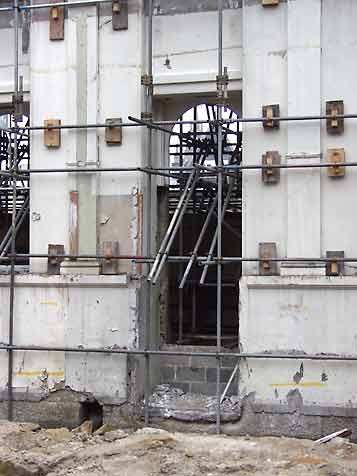
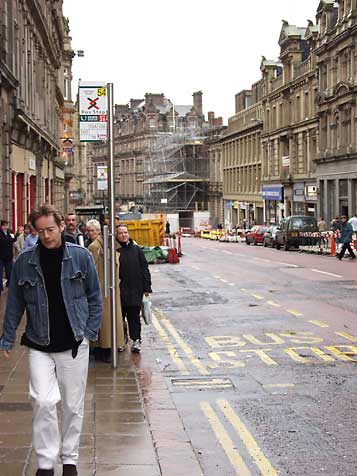
conspired to thwart the demolisher's careful plans. Massive cracks appeared and the structure threatened to collapse and hurried support was required. The buttresses take up one side of Grainger
street and daily traffic chaos is caused by this restriction. Bus routes in the city centre have been hurriedly changed and now Gallowgate and Blackett Street take the increased and much slowed traffic.
|
|
|
 |
 |
|
|
The original idea behind the formation of Trustee
Savings Banks was given impetus by Prime Minister Gladstone in Victorian times.
His Savings Bank Act of 1863 was aimed at strengthening the private savings bank movement by
obliging institutions to certify as trustee savings banks, and at agree to tightly-regulated investment and deposit strategies.
This was aimed at curbing excessive profiteering by banks at the
expense of ordinary savers. The major players that came out of this radical Act were The Post Office Savings Bank, The Yorkshire Penny Bank, and the Trustee Savings Banks.
|
|
|
|
|
|
The TSB movement was started in 1810 by the
Reverend Henry Duncan in the small Scottish village of Ruthwell to improve the financial position of what were then termed the "labouring classes". The constituent savings banks,
were originally voluntary and philanthropic ventures run by local dignitaries. Their aim was to encourage the 'industrial poor' to save for times of ill health, unemployment and old age.
From
1863 their funds were secured by the Government. During both world wars, the savings banks served a crucial role in mobilising personal savings in support of the war effort. Although the savings banks
began to explore the possibility of providing commercial banking services in the 1920s, it took over 50 years for the TSBs to come together to form a modern clearing bank in 1976.
|
|
|
The bank's floatation on the Stock Exchange ended
a philanthropic heritage and before long the bank and its assets were consumed by Lloyd's. This building along with many others country wide was emptied and sold to boost the already massive profits
enjoyed by the new owner's shareholders.
The final near collapse of the building's carcass seemed to symbolise the disintegration of the once proud public spirited organisation that existed within.
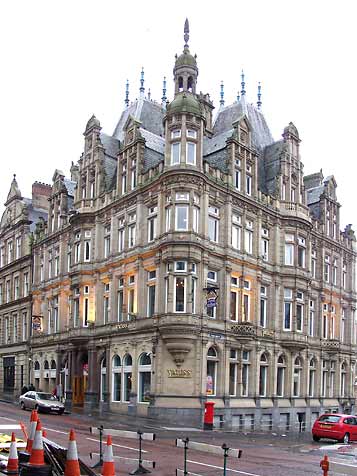
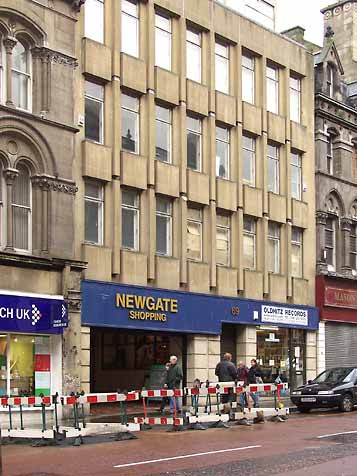
Opposite, John Johnstone's 1886 Newcastle and Gateshead Gas Company premises, now partly a Yates's Wine Bar, looks across with orielled and frilly concern. Once Wenger's Department store, here is
another fine example of a successful change of use that maintains and enhances an historic building.
|
|
|
|
|
|
|
|
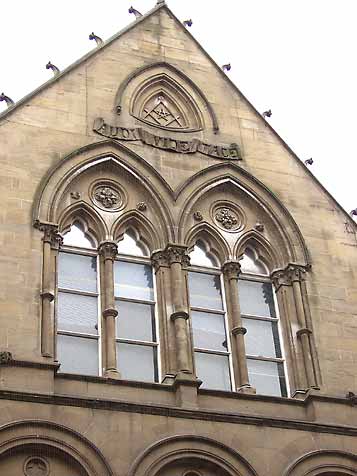
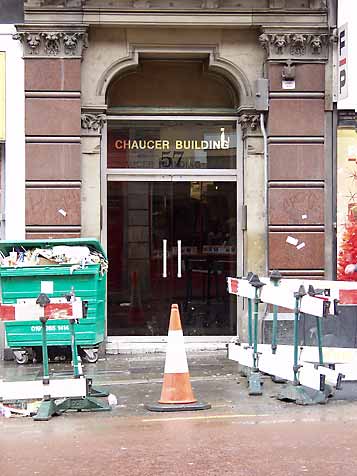
Others overlooking the scene include The Chaucer
Building on the western side of the street.
The fine frontage is topped with this Masonic emblem and a Latin inscription modestly suggesting that we might consider to listen, look, and stay silent
about it.
For many years this was the premises of The Grainger Trust, a property development company with many small holdings throughout the UK and elsewhere, now an arm of local lawyer firm
Dickinson Dees.
Is this another tale of business interests taking over a relatively people friendly concern to turn it into a profit machine? Is that Masonic emblem a purely chance embellishment?
Does Big Business and its fat cat profiteers have more say in the running of the country than the Government?
|
|
|
Next door to The
Chaucer Building is the site of The Empire Cinema that backed onto the Empire Theatre at right angles, whose grand entrance was in nearby Newgate Street.
The whole Empire site was demolished
during the 1960s frenzy. Local politician and self styled saviour of the North East, T. Dan Smith and his Architect and builder friend John Poulson swept aside many serviceable older buildings, replacing
them with hideous non conformity. The basic rules they followed were:
1) Old is bad and must go at all costs.
2) The new must be as cheap as possible,
yet be as profitable as possible for the developer.
3) There should be no reference to the people that use the buildings because "we know best".
|
|
|
|
|
|
A glance to the south from the junction of Bigg
Market and Newgate Street shows the massive scaffold spider holding the old bank edifice from collapsing.
The Tyneside Metro light rail transit system runs in a tunnel under this street and trains
had to be halted whilst the building was made safe, lest the vibration from the underground rumblings should widen the cracks and cause the whole thing to fall down. The trains are running again now that
the walls are shored up with supports.
The cost of this remedial work will be borne by the Demolition company that in turn will claim on indemnity insurance for this very sort of risk. So who
pays? We do, of course, in yet greater insurance costs and banking charges.
|
|
|
When Lloyd's took over the TSB in 1995 it got its hands on the immensely profitable and surplus rich employee
pension scheme. Speaking in The House of Lords on 5th March, 1997 Lord Cobbold said, "The merger between Lloyds and TSB has clearly been in the best interests of shareholders.
However, it is not necessarily in the best interests of all the staff, as the noble Lord, Lord Dubs, pointed out, or indeed of all the pensioners."
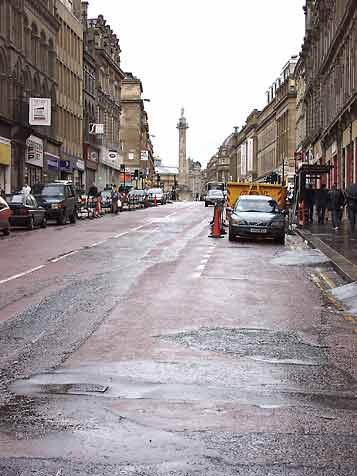
Here, the north view along Grainger Street
shows Earl Grey on his column looking down on the scene. It is thanks to him and his great Reform Act that we now have universal suffrage, and accountable government. Later campaigners secured the vote
for women, and the now accepted lower age of 18 to vote.
|
|
|
|
|
|
We, the people of the UK, have the right to vote in or out the politicians of our choice, both locally and
nationally. We have the right to free speech and the right to propagate our views. We are free to lobby our government representatives so that they look after our interests, and we can find out what they
have been saying from the records of parliamentary proceedings.
In contrast, the real rulers behind their Boardroom doors decide the fate of much of our future. A stroke of the Directorial pen can
seal the fate of a generation.
It is not, therefore, hard to see why the ordinary folk of this land face an impossible task in influencing matters. The Canterbury Tales, written in 1386, capture
the self interest of the day, and suprisingly little has changed down the ages.
|
|
|
|
|
|
|
Site and contents (unless otherwise stated) ©
Tim. Pickford-Jones and Timmonet, Newcastle upon Tyne, United Kingdom.
|
|
|
|
|
|
|
|
 |
|
|
If you should arrive here via a search, or be missing the navigation on the left hand side, click this button.
|
|