|
The Mill Turns
Sat. 13th July, 2002
|
 |
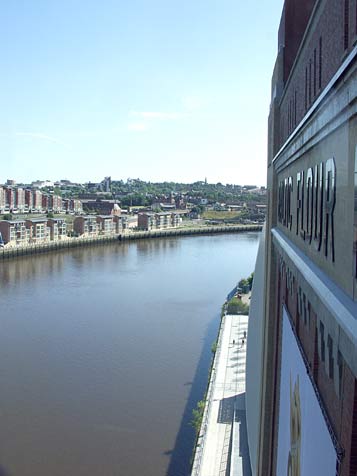
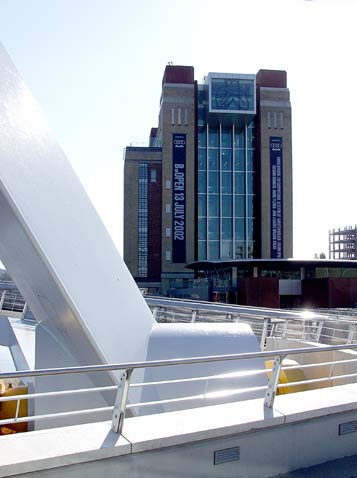
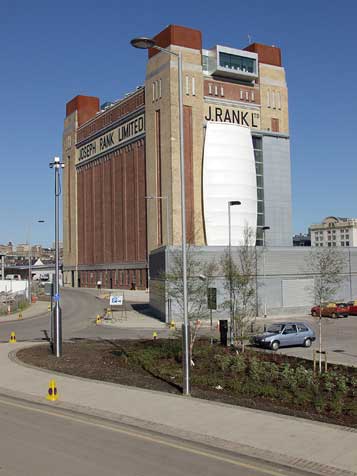
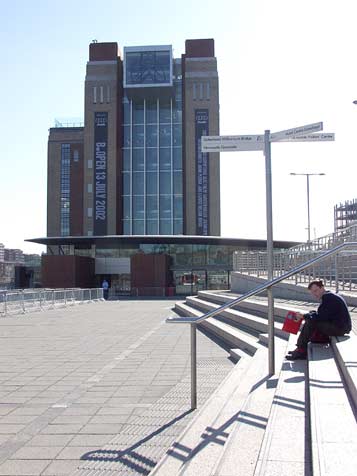
The Baltic was once a flour mill, built in 1950 by Rank, derelict since the early 1980s and saved from the jaws
of demolition. It is now what the Director has dubbed an Art Factory. It houses three galleries, music studios, a media lab and a cinema. The Baltic Contemporary Arts Centre is pivotal to Newcastle and
Gateshead's bid for European City of Culture 2008.
The flour mill and grain silo was originally planned for the late 1930s, but the intervention of the Second World War delayed its
construction. This four tower and curtain wall structure has been a Tyneside landmark for half a century, and is now set to continue in its new guise.
|
|
|
 |
|
|
|
William Thornton was the original architect, and his great grandson, Peter Sandell, was the building project
manager for the new conversion. "I think old William would be well pleased, because he could come back and he could know instantly it was still the Baltic Flour Mill. Then He would be amazed when he
walked inside. We've definitely fulfilled his dream."
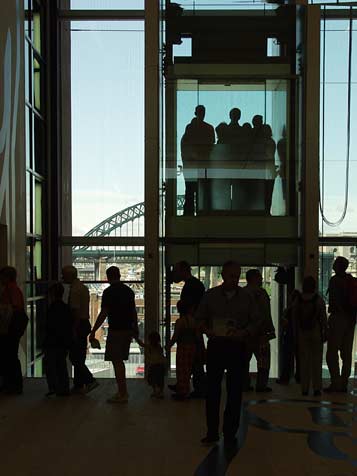
The internal space was once honeycombed with vertical grain storage bins. The centre was hollowed out for the present conversion and
where the original had two floors with storage space between, the chasm is now divided between six floors offering differing yet unique spaces and art venues.
Dominic Williams of London, was the
project Architect. He first started work on the idea in 1994 and was at its completion just weeks ago.
|
|
|
 |
|
|
|
|
|
This is Dominic William's first major project, and aspects of his design have not been without their critics. I
think that the rectangular tacked on viewing boxes at the top of the east and west elevations are trivial and work against the essential verticality of the building.
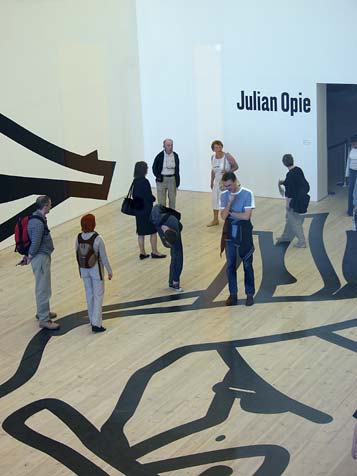
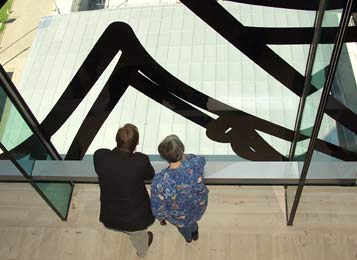
Julian Opie provided the huge
vinyl graphics in the interior and on the nearby bridge houses. The scale of his giant curving human lines is contradictory. Where the puny human form is often used to emphasise the power and scale of
other objects, here the oversized and stylised swishes shout loud across the rooftops yet tend to render the internal spaces cluttered. Opie was born in London in 1958 and trained at Goldsmiths College
from 1979 - 1982.
|
|
 |
|
The Baltic cost £46 million, £33 million of which came via Gateshead Council as a Lottery grant provided that the
Council could match that amount from other sources. The other sponsors were Gateshead Metropolitan Borough Council, English Partnerships through One North East, European Regional Development Fund, The
Regional Arts Board, and Northern Arts.
The Baltic is unique in Lottery funding as, in addition to the building costs, it was awarded funding of £1.5 million per year to provide running expenses.
This sum has been guaranteed for the first five years. Northern Arts and Gateshead MBC, have also assured a contribution for the same period. The Director hopes to raise the rest of the £3 million yearly
running costs from commercial activity.
Sune Nordgren is the founding Director and has devoted thirty years to nurturing and bringing art to the people. Born in Sweden in 1948, he studied Graphic
Art and Art History at Lund University and was editor of Kalejdoskop Review for Contemporary Art for ten years until 1985. Following various posts in TV and print media, always popularising and raising
critical awareness in Sweden, he was appointed Director of Malmö Kunsthall from 1990-96.
His choice of exhibitions demonstrates his graphics background. Let us hope that future shows will contain
more art and less visual diagrams.
Nordgren is acutely aware of the need to create a commercial basis for the Centre. I suspect he will carve a high profile in the media and display contentious
and flagrantly popularist works.
|
|
|
|
|
|
|
|
The whole of level three is given over to Jaume Plensa's gong installation. Nine pairs hang from the ceiling and
visitors are invited to strike notes from "Earth", "Air", "Blood", "Semen", "Chaos", and curiously "Silence".
Here a visitor strikes "Chaos" , an apt description of this gallery's crashing
cacophony.
There is a fitting irony here, as "The Man with the Gong" was a Rank trademark, used on his films, visual media, television production, and was halted only by his acquisition of Xerox
in the mid 1960s whose directors insisted on maintaining their previous corporate identity.
Jaume Plensa was born in 1955 in Barcelona and as his name suggests, is fascinated by the idea of twins.
His other work includes lithographs, film and TV sets, and costume design.
|
|
 |
 |
|
Chris Burden, born in 1946, is an American whose "toys for the boys" approach to art lead him to make scale models
of bridges out of Meccano. Above is an impressive version of Hell Gate Bridge in New York. He gained a B.A. from Ponoma College, Claremont, California, and became a Master of Fine Art at the University of California. His art shows a strong relationship to industry and technology.
Burden was commissioned by the Baltic to produce a scale model of the Tyne Bridge which now stands against one of the side windows so visitors can compare it with the real thing.
The
gallery layout, lighting (augmented by the massive eastern moving shade), and the use of balconies overlooking exhibits all make this a first rate art exhibition space. Its human scale and accessibility
make it a worthy companion to the Tate Modern in London.
The finish in parts is poor. The bare wooden floorboards are already marked and should have been protected by hard wearing varnish. There
is a lack of signs beyond the legally necessary, but this may change with time.
The Baltic is a welcome addition to Tyneside, and a new lease of life to a much loved icon to flour power.
|
|
|
|
|
|
|
|
Also today, the latest annual Chopwell Forest Festival took place.
Managed by the Forestry Commission, The
Friends of Chopwell Wood, and Great North Forest, it is a celebration of woodcraft, tree husbandry, and woodland leisure pursuits.
Chopwell Woods is situated 13 Km south west of Newcastle centre
near Rowlands Gill. It is a managed woodland with woodland trails and educational facilities. One of the major commercial activities is the sale of Christmas trees.
Today a 5 Km main circuit lead
to a variety of exhibitors from coracle building to dry stone walling and plenty more between.
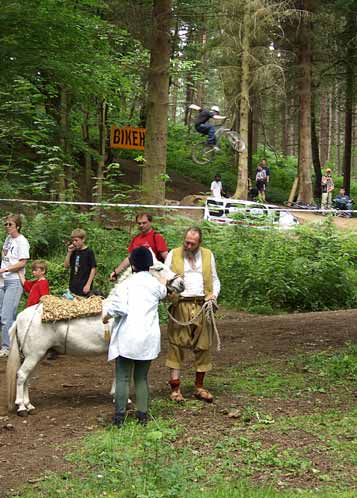
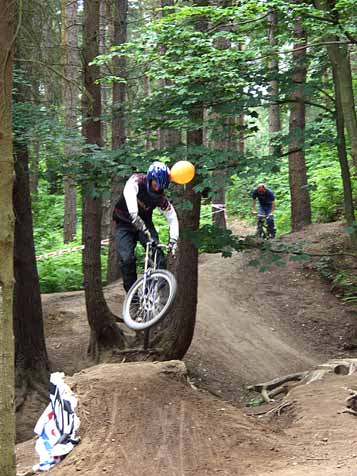
Here the sedate mule transport and nearby pony rides shared space with death defying bicycle
acrobatics.
|
|
|
|
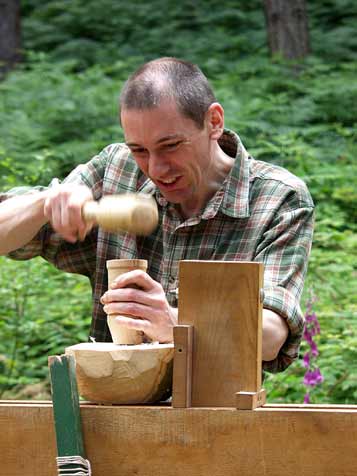
Chris Helliwell is a wood turner who demonstrated his skill here today. The lathes he uses are foot powered and
drive the spindle round by cord wound around one end and stretched between a treadle and a springy branch overhead.
Here he is fitting a centre to a piece he had just chopped with an adze prior to
turning it into a bowl.
His other helpers shaped and turned spindles and gave instructions to visitors who wanted to have a go.
This is not some ethnic display or play acting, the people
here make their livings from these woodcrafts and maintain an oral tradition of methods and skills. It is pleasing to see young people fascinated by these crafts and some willing to take it as a career.
|
|
|
|
|
|
|
|
These flying bikes were a hit with the youngsters. The riders I saw were clearly experienced and the downhill
section with its ramp at the end to propel machines skyward was not for the feint hearted.
The main circuit was punctuated by two entertainment areas and an events arena. At the leisure
areas there were displays of Tai-Chi, music, puppetry, and a variety of craft sales. The Entertainment at the Pines area also boasted a beer hall and a planetarium.
The events arena was host to
axe racing with some amazing displays of men with big choppers slicing through logs as if they were fresh baked loaves.
Throughout the whole circuit some sometimes frightening "Rent-a-Peasant"
with a massive sword or club would leap out. Their leather and rough woven garb was wonderfully created and the people involved were obviously having a wonderful time.
For the very young,
characters from "Wind in the Willows" roamed around, and the object was to meet them all. I particularly liked Mr. Toad (toot toot!).
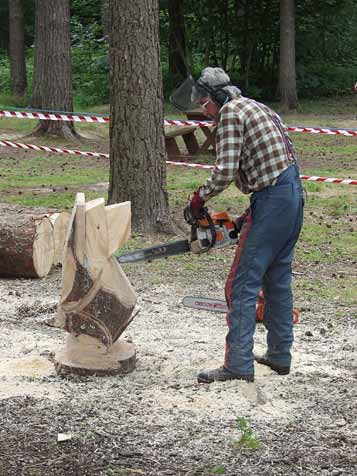
Here Ed Robinson used his chainsaws to produce some impressive
wooden sculptures. We can see him making an owl, and he had previously carved an eagle. He raffled his work at the end of the day. For the safety officers out there, he did use the visor, although he was
wearing shatterproof safety glasses to protect his eyes. Chainsaws should never be used without the full safety kit including ballistic trousers and boots, ballistic gloves, ear defenders and eye
protection.
|
|
|
The variety of handicrafts on sale ranged from beads and small jewellery items to the most exquisite carved wooden
boxes with cleverly concealed hidden compartments and catches.
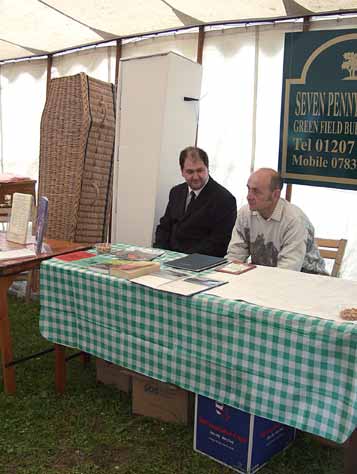
However, my prize for the most weird and fanciful, but taking themselves so seriously, has to go to the Seven Penny Meadows burial
ground scheme.
When the time comes, why not be buried in a wicker basket? Or even cardboard; the ultimate in disposability? Just picture your loved ones tussling with the wobbly load on the way
to the graveside. Of course the cardboard burials can only take place on dry days!
|
|
|
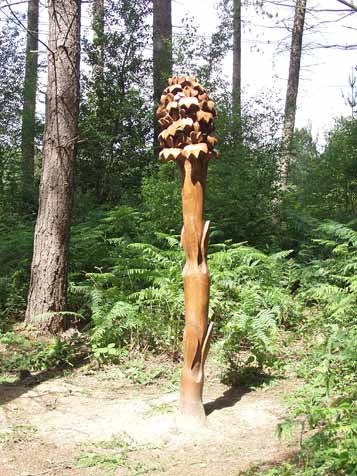
Artist David Goss returned to create another permanent sculpture.
His
"Orchid" was last year's piece and was today basking in the summer sunshine. This year he planned an interactive project with visitors directing the carving of a seat back that will eventually be topped
with a beautiful kestrel.
The Chopwell Forest Festival is a fun and education for all the family. It is truly wonderful that the bustling commercial centre of Tyneside is surrounded by
breathtaking countryside.
|
|
|
Useful links:
The Baltic Centre
The Foretsry Commission
Gateshead Council
Newcastle Council
|
|
|
|
|
|
|
|
Site and contents (unless otherwise stated) ©
Tim. Pickford-Jones and Timmonet, Newcastle upon Tyne, United Kingdom.
|
|
|
|
|
|
|